Safety and continuity of service with Teconex differential circuit breakers
The differential circuit breakerplays an essential role in the protection of people and installations because it ensures both:
- protection against overcurrents (circuit breaker function),
- protection against insulation faults (differential function),
- its choice directly impacts the security, compliance and continuity of service of a professional installation.
In tertiary, industrial, technical buildings or buildings managed by DSOs, the “circuit by circuit” division allowed by the differential circuit breakers avoids global triggering, limits operating losses and reduces emergency interventions.
Teconex offers a coherent range of differential circuit breakers, capable of meeting the requirements of a home as well as an industrial panel or a network managed by a DSO.
Professional differential circuit breakers: reliability, compliance and availability
Teco RCDs are designed to meet the high demands of professional environments, where reliability, compliance and operational stability are essential.
- Normative security: The differential circuit breakers Teco comply with NBN EN 61009-1 standards, based on IEC/EN 61009-1 for domestic and similar uses. Some references also meet Belgian T028 (ex-C10/212) requirements for network applications. Several models bear the CEBEC marking, independent proof of conformity. The technical sheets in the catalog specify the details.
- Effective protection and operating stability: Teco RCBOs offer reliable protection against overcurrents and insulation faults. Their breaking capacity can reach 10 kA depending on the model. Their design limits unwanted triggering linked to common transient overvoltages (motor starting, network switching, electronic loads).
- Controlled manufacturing and consistent quality: Teconex manufactures and assembles the Teco range by controlling the quality of the components and consistency of production. This direct control guarantees stable performance, compatibility between successive series and lasting availability of references.
- Assistance and responsiveness: Teconex teams support installers, design offices, utilities/GRDs and industrialists. The advice takes into account site requirements, operating constraints and the actual availability of references.
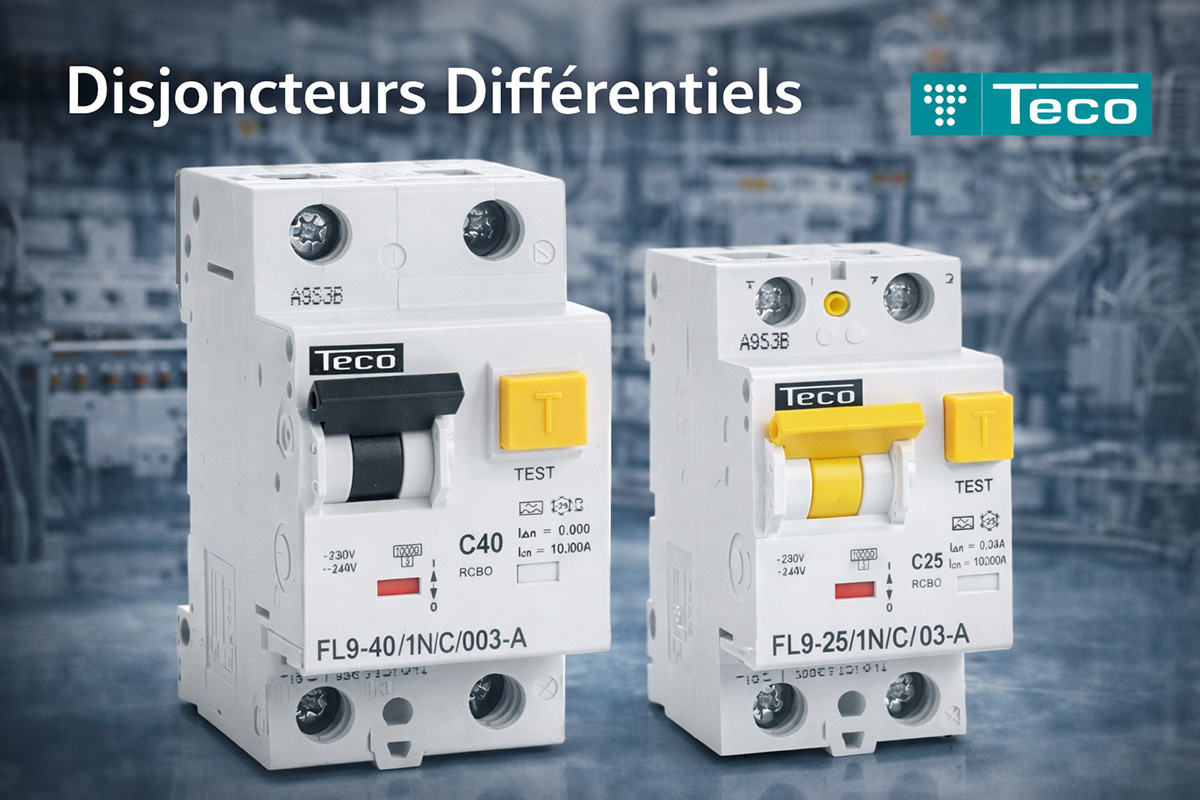
A range of differential circuit breakers adapted to field needs
The range of differential circuit breakers Teco is designed to cover all the configurations encountered in Belgian installations. Thus, it is organized around three parameters: number of poles, tripping curve, and differential sensitivity.
Note: In accordance with RGIE recommendations, all our differential circuit breakers are type A. Our catalog deliberately excludes the AC type, which has become unsuitable in modern installations containing LED drivers, switching power supplies and dimmers. Type A provides reliable fault detection in the presence of DC components and electronic loads.
Number of poles: 1N or 2P
- 1N (protected phase + monitored neutral): very common format, ideal when the neutral must not be cut.
- 2P (phase + neutral cut simultaneously): useful for technical areas, isolated circuits or real two-pole breaking requirements.
| Use / Profile | In | IΔn | Curve | Poles | Teco reference | Comment |
|---|---|---|---|---|---|---|
| Classic single-phase line | 16A | 30mA | B | 1N | FL9161NB003A | Compact RCBO for general circuits. |
| Circuit requiring bipolar break | 10A | 30mA | C | 2P | FL9102C003A | 2P cutoff for technical areas or isolated circuits. |
Magnetothermic curve: B or C
- Curve B: triggers quickly in the event of a fault, suitable for standard circuits (lighting, sockets).
- C curve: better tolerant of current demands — IT, LED drivers, small motors.
| Use / Profile | In | IΔn | Curve | Poles | Teco reference | Comment |
|---|---|---|---|---|---|---|
| Standard circuit | 20A | 30mA | B | 1N | FL9201NB003A | For loads without marked current draw. |
| Technical loads or light engines | 32A | 30mA | C | 1N | FL9321NC003A | Absorbs transient spikes. |
Differential sensitivities: 10 / 30 / 100 / 300 mA
- 10 mA: environments requiring ultra-fast detection (sensitive premises).
- 30 mA: personal protection, Belgian standard.
- 100 mA: intermediate levels for technical circuits.
- 300 mA: local fire protection (without replacing the general 300 mA).
| Use / Profile | In | IΔn | Curve | Poles | Teco reference | Comment |
|---|---|---|---|---|---|---|
| Highly sensitive detection | 6A | 10mA | B | 1N | FL961NB001A | Very high sensitivity for specific uses. |
| Intermediate level for technical | 16A | 100mA | C | 1N | FL9161NC01A | Sensitivity adapted to non-domestic circuits. |
| Local fire protection | 25A | 300mA | B | 1N | FL9251NB03A | Detection of significant faults on dedicated circuits. |
Choose a differential circuit breaker according to the application
Current circuits (residential / light tertiary)
Light structures (kitchens, cabinets, small technical rooms) do not generally require a curve C. Curve B is more than sufficient for the majority of domestic and light tertiary installations, as long as the loads do not create a significant current draw.
These are the most common differential circuit breakers in residential, small business or office switchboards.
| Use | Curve | Sensitivity | Caliber | Teco reference |
|---|---|---|---|---|
| LED lighting, sockets, small appliances | B | 30mA | 16A | FL9161NB003A |
| Standard single-phase circuits | B | 30mA | 20A | FL9201NB003A |
| Slightly busier circuits | B | 30mA | 25A | FL9251NB003A |
Circuits with light current draw (computers, electronic power supplies, small motors)
When a circuit powers loads with higher current draw — switching power supplies, computers, professional LED blocks, small fans, compact pumps — the C curve becomes preferable. It absorbs transient peaks without unwanted triggering.
We find these profiles of differential circuit breakers in light IT rooms, modest workshops or modern offices very equipped with electronics.
| Use | Curve | Sensitivity | Caliber | Reference |
|---|---|---|---|---|
| Electronics / IT | C | 30mA | 10A | FL9102C003A |
| Mixed LED + IT circuits | C | 30mA | 16A | FL9162C003A |
| Moderate technical groups | C | 30mA | 20A | FL9202C003A |
Technical circuits / specialized premises
Some circuits require a maximum differential sensitivity of 10 mA (very rapid detection), for example in high-risk premises, laboratories, specific installations or light medical equipment.
Other circuits, technical or specific, may require 100 mA sensitivities, especially when fire protection must be local but more permissive than 30 mA.
| Use | Curve | Sensitivity | Caliber | Reference |
|---|---|---|---|---|
| Sensitive premises (increased detection) | B | 10mA | 6A | FL961NB001A |
| Technical rooms with possible HF leaks | C | 10mA | 10A | FL9101NC001A |
| Technical equipment (light HVAC, automation) | C | 100mA | 25A | FL9251NC01A |
Circuits requiring cumulative leakage immunity
In installations where several electronic loads coexist on the same feeder, common mode leaks can add up. Using RCBO 100 mA or 300 mA on circuits not intended directly for personal protection can stabilize operation.
| Use | Curve | Sensitivity | Caliber | Reference |
|---|---|---|---|---|
| Massive LED lighting / clustered computing | C | 100mA | 32A | FL9321NC01A |
| Sensitive technical departures | B | 100mA | 20A | FL9201NB01A |
| Slightly busy lines (small tertiary sector) | B | 300mA | 32A | FL9321NB03A |
Very busy circuits
For powerful single-phase feeders – HVAC units, small industrial machines, heavy technical groups – you need an RCBO capable of handling significant currents and high load demands. The 40 A rating is common in the tertiary and small industrial sectors, especially when you want to isolate each machine via a dedicated differential circuit breaker.
| Use | Curve | Sensitivity | Caliber | Reference |
|---|---|---|---|---|
| Powerful single-phase start | B | 30mA | 40A | FL9401NB003A |
| Technical start with high tolerance | C | 30mA | 40A | FL9401NC003A |
| Fire protection of a specific circuit | B | 300mA | 40A | FL9401NB03A |
Why choose Teconex for its differential circuit breakers?
Belgian professionals — installers, design offices, industries and utilities — are looking for RCDs that are reliable, available, documented and adapted to modern electronic loads.
In this area, Teconex has concrete advantages:
- Local and competent technical support: Our teams know Belgian habits (RGIE, three-phase architecture, drives, PV, EV terminals). The responses are quick and pragmatic.
- Coherent and stable catalog: The families of differential circuit breakers (and others) remain monitored and documented. For an installer, no surprises and this makes panel extensions easier in the long term.
- A complete and readable range: Curves B and C, from 6 A to 40 A, sensitivities from 10 to 300 mA, 1N or 2P versions: the range of differential circuit breakers covers all the realistic cases encountered in professional switchboards.
- Homogeneous ergonomics and consistent wiring: The Teco RCBOs share the same modular format, the same terminal blocks and the same wiring logic as the other Teco lines. This continuity facilitates extensions, replacements and work in existing panels, without dimensional or connection surprises.
- Perfect compatibility with Teco differential switches: Our RCBO integrates unambiguously into a Teco-only architecture:
- Type A systematic,
- PoC 10 kA,
- Consistent behavior in the face of defects,
- Ability to properly prioritize critical areas.
Need more advice? Check out our other articles:
Privileged partners of more than 500 wholesalers, network managers, architects and large contractors across Europe, we are always available to help them meet the challenges of their respective fields.
Your projects deserve our full attention.
Ask us!