The role of the differential switch in a professional installation
The differential switch is one of the essential protection devices for an electrical installation. It monitors leakage currents to earth and intervenes as soon as they exceed the admissible value, in order to limit the risks of electrification and insulation faults.
In practice, thedifferential switch occupies three essential roles:
- fire protection at the head of the installation (300 mA), mandatory in Belgium,
- protection of people on exposed circuits (30 mA),
- intelligent segmentation of a table to avoid cascading triggers.
In professional installations (tertiary, industrial, IT, data centers, HVAC, etc.), it also becomes a service continuity tool: a bad choice of type, sensitivity or selectivity can bring down an entire line for a simple localized fault. Hence the importance of a consistent choice between nature of loads, environment, switchboard architecture and regulatory requirements.
Teco differential switches are certified according to the applicable standards (EN 61008, EN 62423 for types A and B), and offer variants adapted to different installation topologies: 2P or 4P, ratings up to 100 A, selective, digital versions, and types adapted to modern electronic loads.
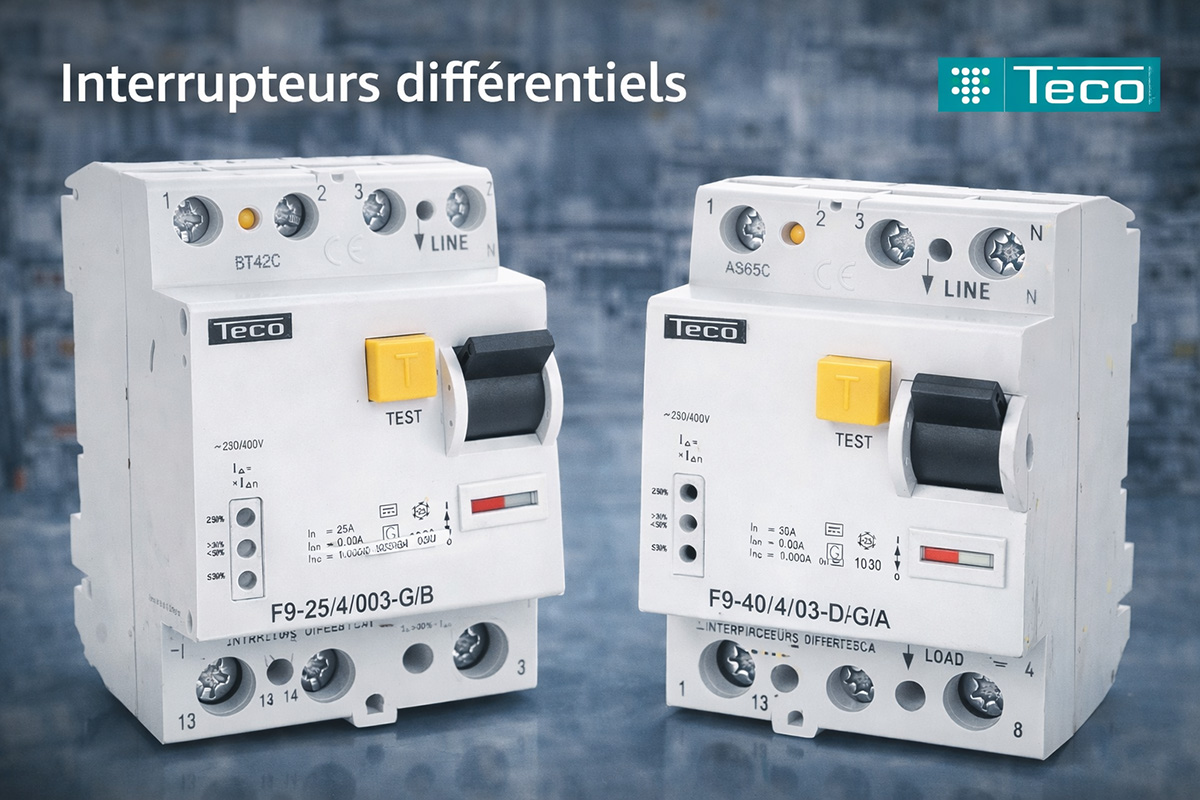
The main families of Teco differential switches
The Teco range of differential switches is designed to cover very different scenarios, ranging from simple domestic cabinets to industrial panels heavily loaded with power electronics. It is designed to meet the real constraints of the field: robust mechanics, strict normative compliance, readability of references and guaranteed availability.
2P and 4P differential switches: for single-phase or three-phase installations
A 2-pole differential switch protects a single-phase line (phase + neutral). In Belgium, three-phase panels are very common: we then use a 4-pole differential switch (Or four-pole differential switch) to simultaneously monitor L1, L2, L3 and neutral, even when the downstream feeders are mainly single-phase.
| Installation topology | Caliber (In) | Sensitivity | Teco reference | Comment |
|---|---|---|---|---|
| Single phase panel | 25A | 30mA | F9252003A | Inter diff 2P for phase + neutral. |
| Single phase with multiple loaded circuits | 40A | 30mA | F9402003A | 2P with more margin for cumulative charges. |
| Three-phase panel with distributed single-phase circuits | 40A | 30mA | F9404003A | 4P to monitor the 3 phases + neutral. |
| Tertiary three-phase panel or small workshop | 63A | 30mA | F9634003A | 4P suitable for heavier circuit groups. |
| Head of a three-phase panel (fire protection) | 80A | 300mA | F980403A | General differential 300 mA for upstream of the installation. |
Choice of nominal rating (In): from 16 A to 100 A depending on the model
The rating has no effect on the differential sensitivity, but it conditions the ability of the differential switch to withstand the permanent current of the group of circuits it supplies. In the tertiary or industrial sector, it is common to go up to 63 A or 80 A when several heavily loaded feeders are combined under the same ID.
| Caliber In | Poles | Sensitivity | Teco reference | Recommended use |
|---|---|---|---|---|
| 25A | 4P | 30mA | F9254003A | Small three-phase switchboard or lightweight sub-panel. |
| 40A | 4P | 30mA | F9404003A | Moderate charges in tertiary or collective residential. |
| 63A | 4P | 30mA | F9634003A | Groups combining lighting + sockets + IT. |
| 80A | 4P | 300mA | F980403A | General differential 300 mA, depending on downstream loads. |
| 100A | 4P | 300mA | F9100403A | Upstream of tertiary or heavy industrial installation. |
| 63A | 4P | 300 mA (selective S-A) | F963403SA | Selective at the head of several stages 30 mA. |
Available sensitivities (IΔn)
To illustrate the sensitivities available in the Teco range, here are some representative references and their usual use.
| Sensitivity | Caliber | Poles | Kind | Teco reference | Typical usage |
|---|---|---|---|---|---|
| 10mA | 16A | 2P | HAS | F9162001A | Very sensitive or local specific circuits. |
| 30mA | 25A | 2P | HAS | F9252003A | Protection of people in single phase. |
| 30mA | 40A | 4P | HAS | F9404003A | Lightweight three-phase panels or distributed circuits. |
| 30mA | 63A | 4P | HAS | F9634003A | Groups of circuits combining lighting / sockets / IT. |
| 100mA | 25A | 4P | HAS | F925401A | Technical areas where wider detection is acceptable. |
| 100mA | 63A | 2P | HAS | F963201A | Dedicated single-phase line with specific technical constraints. |
| 300mA | 40A | 4P | HAS | F940403A | Fire protection of a small three-phase panel. |
| 300mA | 80A | 4P | HAS | F980403A | General differential 300 mA depending on the nature of the downstream loads. |
| 500mA | 63A | 4P | HAS | F963405A | Technical or industrial installations where 300 mA would be too sensitive. |
Choice of detection type (A / F / B / S-B / digital)
The detection type of a differential switch determines the forms of leakage current it can correctly analyze: sinusoidal, rectified, high frequency, DC component, etc. With the widespread use of drives, switching power supplies, inverters and charging stations, this choice has become as determining as the rating or sensitivity.
The Teco range is structured into clearly distinct families, each available in several calibers and sensitivities. The table below brings together some representative references.
| Type / family | Variant | Typical Sensitivities | Typical calibers | Teco references (examples) | Recommended use |
|---|---|---|---|---|---|
| Type A standard | Classic or digital | 30mA, 100mA, 300mA | 25 A to 100 A | F9404003A (4P 40 A 30 mA), F925401A (4P 25 A 100 mA), F980403A (4P 80 A 300 mA), F9404003DGA (4P 40 A 30 mA digital) | Usual residential circuits, simple tertiary circuits, light electronic loads. |
| Type A “var. frequency » | Digital – increased resistance HF | 30mA | 40A, 63A | F9404003DU (4P 40 A 30 mA), F9634003DU (4P 63 A 30 mA) | Circuits with switching power supplies, HF LEDs, light dimmers. |
| Type B | Standard digital | 30mA, 300mA | 25A, 40A, 63A | F9254003GB (25 A 30 mA), F9404003GB (40 A 30 mA), F963403GB (63A 300mA) | Drives, PV, EV inverters, elevators, machines producing residual DC. |
| Type B “var. frequency » | Digital – broadband | 30mA, 300mA | 25A, 40A, 63A | F9254003GBFQ (25 A 30 mA), F9404003GBFQ (40 A 30 mA), F963403GBFQ (63A 300mA) | Industrial machines heavily equipped with drives, broadband variators. |
| Type S-A (selective type A) | Digital – selective | 300mA | 40A, 63A, 80A | F940403DSA (40 A 300 mA), F963403DSA (63 A 300 mA), F980403DSA (80A 300mA) | Upstream of panels with several 30 mA stages downstream. |
| Type S-A “var. frequency » | Digital – selective HF | 300mA | 40A, 63A, 80A | F940403DU (40 A 300 mA), F963403DU (63 A 300 mA), F980403DU (80A 300mA) | Selective upstream in installations exposed to HF disturbances (drives). |
| Type S-B (selective type B) | Digital – selective | 300mA | 25A, 40A, 63A | F925403SB (25 A 300 mA), F940403SB (40 A 300 mA), F963403SB (63A 300mA) | Installations with type B loads downstream: EV, PV, drives, elevators. |
| Type S-B “var. frequency » | Digital – selective broadband | 300mA | 25A, 40A, 63A | F925403SBFQ (25 A 300 mA), F940403SBFQ (40 A 300 mA), F963403SBFQ (63A 300mA) | Upstream of industrial installations heavily loaded with drives and inverters. |
Choose the type of differential switch according to the nature of the installation
The detection type determines what thedifferential switch is actually capable of monitoring. Today, the majority of installations include power electronics: LEDs, switching power supplies, dimmers, PV inverters, charging stations, HVAC, PLCs, etc.
These loads generate non-sinusoidal leakage currents, sometimes high frequency, sometimes with DC component. A poorly chosen type is a differential which saturates, no longer analyzes the leak correctly, or trips for no apparent reason.
The range of differential switchesTeco covers all current technical needs: Type A, Type F / A var. frequency, Type B, Type B var. frequency, and the selective S-A and S-B versions (with or without variable frequency). Depending on the nature of the installation, the approach changes.
Domestic and collective residential installations
In this context, the objective of the differential switch is to protect people and maintain good selectivity between the general 300 mA differential and the 30 mA downstream. The basic rule is simple:
- Type A mandatory, in accordance with the RGIE.
- 30 mA on sensitive circuits (humid, exterior, household appliances).
- Selective 300 mA differential upstream for fire protection.
Teco offers several models adapted to these uses, in standard or digital versions, from 25 A to 80 A.
| Use | Kind | Sensitivity | Caliber | Teco reference | Comment |
|---|---|---|---|---|---|
| Fire protection (at the top) | S-A (selective) | 300mA | 40A | F940403DSA | Selective general differential, ideal at the head of the installation. |
| Fire protection (loads that may require B downstream) | S-B (selective) | 300mA | 25A | F925403SB | Type B selective version, useful if EV/PV downstream. |
| Protection of people (sensitive areas) | Type A | 30mA | 40A | F9404003A | 4P differential suitable for Belgian three-phase/mixed installations. |
| Personal protection (heavier circuit group) | Type A | 30mA | 63A | F9634003A | To group several “classic” circuits without leakage overload. |
| Easy diagnosis | Type A Digital | 30mA | 40A | F9404003DGA | Digital version: simple diagnosis, very useful for renovated installations. |
Tertiary installations (offices, shops, schools, ERP)
The tertiary sector is dominated by electronic loads: LED, IT, switching power supplies, light PLCs, UPS, HVAC. These loads often produce high frequency leaks, which can saturate a classic type A if several feeders are grouped.
- Type A in the majority of cases.
- Type A “var. frequency” (reinforced A) when HF leaks are significant.
- Increased segmentation: avoid stacking too many computer circuits under a single 30 mA.
In the case of an electrical installation in the tertiary sector, the typical problem is not the absence of protection, but the excess of circuits on a single 30 mA differential. The cumulative leaks cause “unexplained” triggering. Multiplying IDs remains the most stable strategy.
Here is a suggestion for differential switchesTeco for this type of installation. The digital versions are recommended for technical premises where maintenance must be rapid:
| Use | Kind | Sensitivity | Caliber | Teco reference | Comment |
|---|---|---|---|---|---|
| General protection | S-A (selective) | 300mA | 63A | F963403DSA | Good choice at the top or tertiary sub-table. |
| Personal protection | Type A | 30mA | 40A | F9404003A | Safe value for LED circuits + light IT. |
| Multiple electronic charges | Type A Var. Frequency | 30mA | 40A | F9404003DU | More stable when many switching power supplies coexist. |
| Computer circuit groups | Type A | 30mA | 63A | F9634003A | Allows the cumulative HF leaks from several IT feeds to be absorbed. |
| Fast maintenance | Type A Digital | 30mA | 63A | F9634003DGA | Immediate visual diagnosis, very appreciated in tertiary sites. |
Industrial and technical installations
This is the natural terrain for type B differential switches and variable frequency versions. Variable speed drives, HVAC drives, elevators, compressors, PV inverters, robots, CNC machines, etc. generate continuous leaks (DC), strongly distorted, sometimes at very high frequency, and significant enough to completely saturate a type A.
A differential switch type A, even new, can become partially blind in such a context. Consequently, it is preferable to opt for:
- Type B as soon as a load can generate a residual DC component.
- Type B var. frequency for broadband drives, demanding industrial environments.
- High ratings (63–100 A) to absorb “normal” machine leaks and avoid unwanted tripping.
- Selective S-A or S-B versions upstream, especially when you have several machine lines downstream.
Find below examples of differential switchesadapted from the Teco range:
| Use | Kind | Sensitivity | Caliber | Teco reference | Comment |
|---|---|---|---|---|---|
| Drives, elevators, EV, PV | Type B | 30mA | 40A | F9404003GB | For loads with DC component. |
| Industrial machines with broadband drives | Type B Var. Frequency | 30mA | 40A | F9404003GBFQ | Reinforced version for industrial drives. |
| Powerful loads with variators | Type B | 300mA | 63A | F963403GB | For groups of machines or industrial HVAC. |
| Upstream multi-line machine protection | S-B Selective | 300mA | 63A | F963403SB | Selective Type B — prevents the upstream from triggering before the downstream. |
| Harsh environments with variable frequency | S-B Var. Frequency | 300mA | 63A | F963403SBFQ | Ideal upstream of several lines equipped with variators. |
Differential discrimination: organize the 300 mA / 100 mA / 30 mA stages
The objective of differential selectivity is simple: to ensure that a localized fault does not shut down the entire installation. To achieve this, it is necessary to organize the differential switches by stages, by adjusting two levers: sensitivity (IΔn) and response time.
In a coherent architecture, upstream must always be less sensitive and slower than downstream. This is the role of selective models (type S, S-A or S-B) whose integrated time delay allows time for the downstream differential to trigger first. Without this delay, an instantaneous 300 mA can very well react before a 30 mA, which cancels any logic of selectivity.
In a Belgian context, the most frequent logic is based on:
- A selective 300 mA (S-A or S-B depending on the loads present),
- Possibly an intermediate stage (for example 100 mA),
- And instantaneous 30 mA placed as close as possible to sensitive circuits.
In tertiary or industrial panels, this principle is available on several levels when sub-panels or groups of machines must remain isolated. The selective Teco differential switch models — in versions A, B and B with variable frequency — are precisely designed for this upstream use, while remaining compatible with the cumulative leaks specific to professional environments.
Differential selectivity must also be distinguished from short-circuit selectivity, which depends on the circuit breakers and their tripping curves. Both must be consistent, but they respond to different physical phenomena. Hence the interest, in many installations, of composing a hierarchy combining “differential switch + modular circuit breakers”.
Management of circuit groups: sizing and balancing
In Belgium, the RGIE notably imposes a maximum of eight circuits per 30 mA differential in domestic. In professional settings, this limit does not formally exist, but the technical logic remains the same: the less a differential switch is loaded with circuits and cumulative leaks, the more stable its behavior.
Rated current (In)
A differential switch does not protect against overcurrents, but it must support without stress the permanent current of all the feeders it supplies. In a tertiary panel where a single ID brings together lighting, HVAC and IT, choosing a 63 A or 80 A rather than a 40 A provides a better thermal margin and reduces the risk of triggering linked to cumulative leaks.
Phase balancing
In three-phase panels, correct load distribution remains essential. A strong imbalance can increase the current in the neutral. The differential switch does not distinguish a neutral current due to an imbalance from a real leakage current: if the imbalance is added to harmonic or high frequency currents, nuisance tripping becomes more probable.
The Teco 4P IDs are designed to operate with common load imbalances, but a poorly balanced architecture can bring them to their limit and promote nuisance tripping.
The nature of “fugitive” charges
Certain loads generate normal but significant leakage currents:
- washing machine, dryer, dishwasher,
- computer power supplies,
- drives and inverters,
- low-end LED lighting,
- EV charging stations.
Grouping too many leaky loads behind the same 30 mA increases the risk of trips without a real fault. Experienced installers therefore systematically segment these circuits, even when regulations do not require it.
The range of differential switchesTeco, with its extended ratings and its versions adapted to electronic loads, allows each group to be dimensioned with an appropriate model: 40 A for current circuits, 63 A or 80 A for IT areas or groups of machines.
RGIE summary: the Belgian standard on differential switches
The Belgian RGIE is clear on the essential points for differential protection. The following constitutes the hard core to integrate into any project:
- A 300 mA differential is mandatory at the origin of each installation: It protects against fire risks linked to insulation faults. In practice, it is almost always installed in a selective version, to maintain good coordination with downstream stages.
- Sensitive circuits must be protected by 30 mA: Bathtub, shower, washing machine, dishwasher, external sockets, etc. These areas present a direct risk to people.
- Type AC is no longer permitted in domestic use in new or renovated installations: A type A differential switch becomes the minimum required, which corresponds to the nature of modern loads.
- Maximum 8 circuits per 30 mA differential in domestic: Even if this limit does not concern the tertiary sector, the technical logic remains valid: beyond a certain number of circuits, the cumulative leaks become difficult to control.
- Modern electronic loads may require suitable types: For drives, machines with rectification, certain charging stations or certain photovoltaic inverters, the use of a differential switch type B may be required or recommended depending on the equipment. The objective is to avoid saturation linked to the DC component.
- Selectivity is strongly recommended as soon as several stages coexist: Without selectivity, a local fault cuts off the entire upstream: the installation becomes less reliable and more difficult to diagnose.
This RGIE synthesis constitutes a secure base for architecting a clean, reliable and compliant panel, whether it is a residential building, an industrial hall or a tertiary building.
The Teconex differential switch range at a glance
Teco offers a range of differential switches designed to cover all the situations encountered in Belgium: single-phase and three-phase networks, linear or electronic loads, residential, tertiary and industrial panels. The objective is not only to offer several references, but to provide a coherent, architectable and complete range, capable of meeting each need without mixing brands or technical compromises.
The range is structured around several clearly defined families:
- Ratings from 16 to 100 A, in 2P and 4P, to constitute upstream and downstream stages adapted to the actual permanent current of the installations.
- All the usual sensitivities (10 mA, 30 mA, 100 mA, 300 mA, 500 mA), with instantaneous versions and, for certain values, selective versions, to correctly organize the differential selectivity.
- Types A, A var. frequency, B, B var. frequency, covering most of the electronic loads encountered in modern installations: LEDs, switching power supplies, drives, EVs, PV, elevators, CNC.
- Selective versions S-A, S-B and S-B var. frequency, designed for upstream work in multi-stage installations, where coordination of differentials is essential.
- Digital models (A, B and S-A/S-B), which add diagnostic functions, status reading and better visibility in a technical environment — very popular in the tertiary and industrial sectors.
- Strict compliance with EN 61008 and EN 62423 standards, with Type B versions certified for DC component detection.
- Stock availability and range continuity, an essential point for installers who must maintain or extend existing panels.
The assembly has been designed to allow the installer to build a homogeneous “Teco only” architecture, from selective 300 mA upstream to specialized 30 mA downstream. Variable frequency versions and digital models make it possible to correctly deal with modern installations, where the coexistence of electronic loads and variators requires suitable differentials.
This consistency is also based on robust mechanics, stable manufacturing from one reference to another, and a warranty policy aligned with professional uses. The result is a range of differential switches which are easily installed, hold up well over time, and meet the current constraints of the Belgian market - residential, tertiary or industrial.
Need more advice? Check out our other articles:
Privileged partners of more than 500 wholesalers, network managers, architects and large contractors across Europe, we are always available to help them meet the challenges of their respective fields.
Your projects deserve our full attention.
Ask us!